
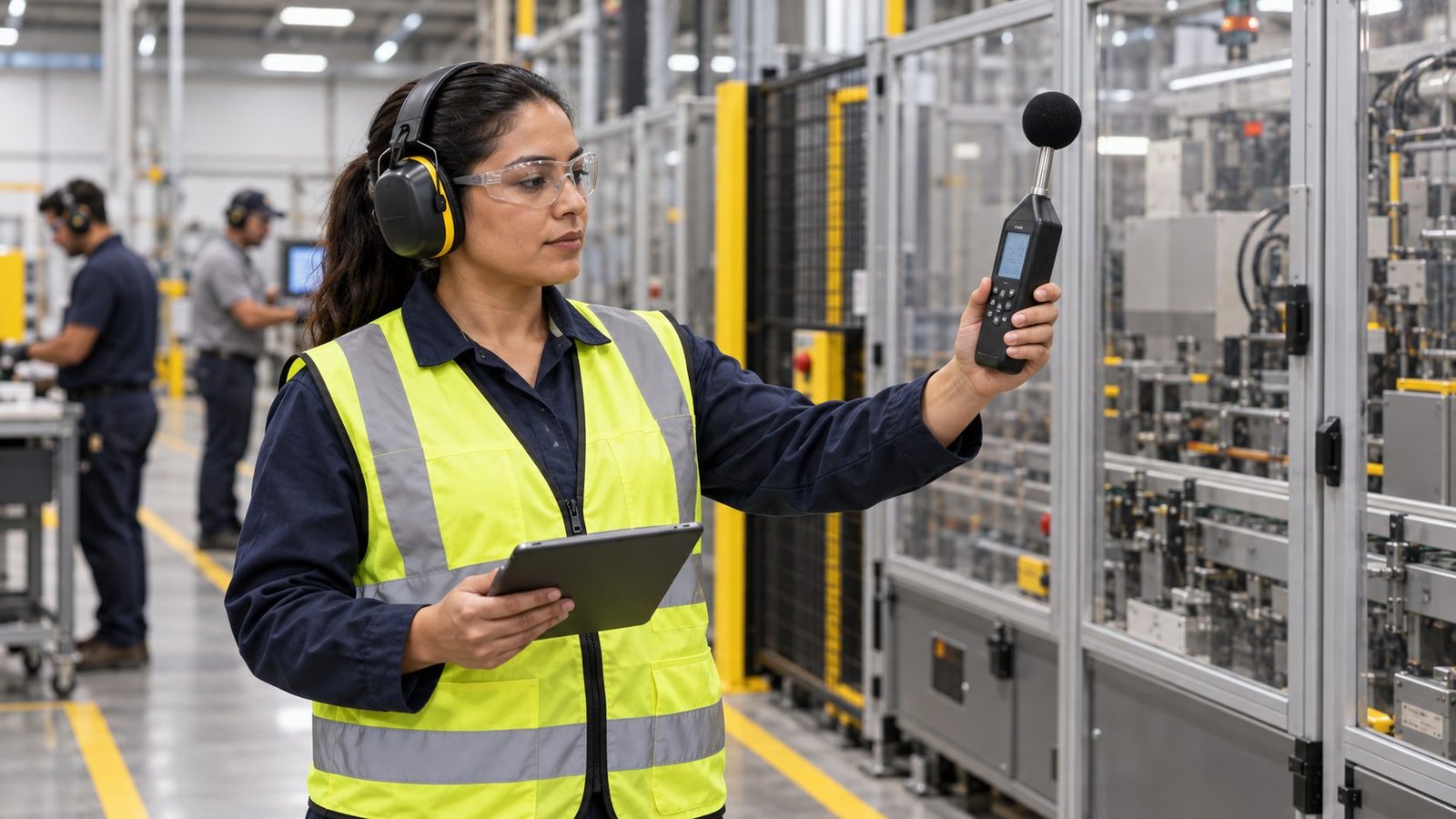
Find out how loud it really is.
Noise surveys, personal dosimetry, audiometric testing, and a hearing conservation program that answers the first question an inspector will ask. How do you know?
When noise reaches an 8-hour average of 85 dBA, OSHA requires a hearing conservation program with exposure monitoring, audiometric testing, hearing protection, annual training, and records. At 90 dBA, engineering or administrative controls come into play.
NIOSH recommends a stricter limit of 85 dBA over 8 hours, with less time allowed as levels rise. We report both, and show where the NIOSH recommendation is stricter.
If people have to raise their voices to be heard at arm's length, the area deserves a measurement.
At 100 dBA, OSHA allows 2 hours. NIOSH recommends 15 minutes.
Time a worker can spend at each sound level before reaching a full day's noise dose.
What we collect. What the lab does. What it means.
Every proposal spells this out for your job. Here is the general shape.
What we collect
Sound level readings and full-shift personal dosimetry during real work.
Audiometry
We perform baseline and annual audiograms, run by a CAOHC-certified hearing conservationist with calibrated equipment in a qualified test environment. Problem audiograms go to our audiologist for the review 29 CFR 1910.95 requires.
What we interpret
Exposures against the OSHA action level of 85 dBA and the limit of 90 dBA as an 8-hour average, with the NIOSH recommendation reported where it's stricter. Audiogram review and any medical judgment belong to an audiologist or physician.
Before we arrive
Shift and task schedule, a quiet space for testing, and for baseline tests, 14 hours without workplace noise exposure. Wearing hearing protection during that time meets the requirement.
Four steps. No surprises.
Survey the space
Map sound levels to find the loud areas and tasks.
Measure each worker
Personal dosimeters capture each worker's full-shift exposure.
Build the program
Baseline and annual audiometric testing, protector selection, training, and recordkeeping.
Educate the workforce
Annual hearing conservation training, delivered and documented.
Where it fits
- Manufacturing and fabrication floors
- Warehouses with conveyors and equipment
- Mechanical rooms and plant operations
- Construction tasks with saws, breakers, and compressors
What you walk away with.
- 8-hour exposure results by person and area
- A clear call on who is in the program
- A written hearing conservation program
- Training records
Start with a Gap Analysis.
We compare what applies to your site with what you have on file, and price what it takes to close each gap.
Tell us
what's due.
Fit tests. Hearing conservation. Air sampling. Water sampling. OSHA training. Written safety programs. Site audits. Give us the site, the headcount, and the date. You'll receive scope, pricing, and deliverables in writing, in a proposal.